
How Long Does a Roof Last in Texas? (And How to Add Years to Yours)

Updated: Aug 9
The shingle wrapper says 30 years. Your North Texas roof would like a word. Between 100-degree summers, freeze cycles, 60-mph gust fronts, and annual hail season, real-world lifespans here run well below the marketing number. Here's what to actually expect — and how maintenance moves the needle.
Real-world lifespans in North Texas
Three-tab shingles last 10–15 years here (and are increasingly hard to insure). Architectural shingles run 15–22 years. Class 4 impact-resistant shingles reach 20–25+ years. Metal can go 40+ with proper installation. But the single biggest variable isn't the shingle — it's ventilation and maintenance.
What kills Texas roofs early
Heat plus poor attic ventilation cooks shingles from underneath, curling edges years early. Neglected small failures turn a $150 pipe boot into a $3,000 decking repair. Clogged gutters back water up under the shingle edge and rot fascia. Storm damage nobody documented fails quietly over 12–24 months. And bad installation — nail placement and flashing details you can't see from the ground — shaves years off even premium materials.
The maintenance that actually adds years
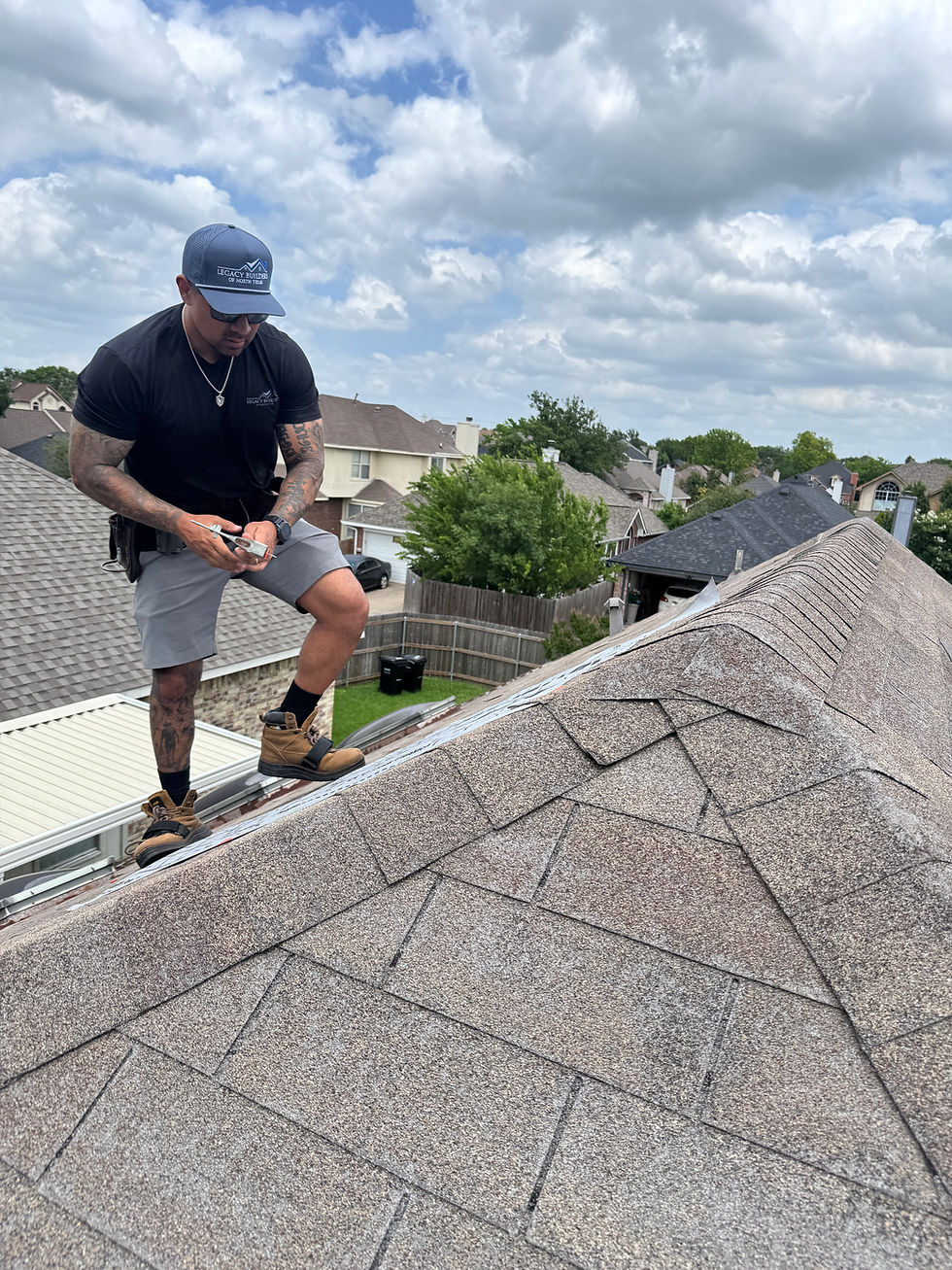
An annual tune-up — resealing exposed nail heads, replacing cracked pipe boots, checking flashing, clearing valleys — is the cheapest insurance a homeowner can buy. It's exactly what our Legacy Shield membership systematizes: scheduled inspections, photo documentation, small fixes on the spot, and priority storm response for members across Denton County.
The documentation bonus
A maintained roof with records performs better twice: in storms, because small vulnerabilities are already fixed, and in claims, because carriers respond differently to documented maintenance history than to "we never looked at it." It matters at resale too.
The Bottom Line
You can't control the weather. You can control ventilation, maintenance, and who installs your roof. Get those three right and a North Texas roof reaches the top of its range instead of the bottom.
Questions We Get Asked
My shingles are rated for 30 years. Why are you telling me 18?
That rating comes from a lab, not a North Texas summer. Manufacturer numbers assume moderate temperatures, decent ventilation, and no hail. Here you get 100-degree attics, freeze cycles, and a hail season every spring. Architectural shingles that would genuinely reach 30 years in a milder climate typically run 15 to 22 here. Ventilation is what moves you toward the top of that range.
Does an annual tune-up actually add years, or is it just a service call?
It adds years when it catches the small things early. Exposed nail heads, cracked pipe boots, and lifted flashing are what let water in long before the shingles themselves wear out. A pipe boot replaced on schedule for around $150 is the difference between a dry attic and a $3,000 decking repair. Shingles are rarely what fails first.
How do I know if my attic ventilation is the problem?
From the ground, you usually can't. The evidence is in the attic and on the roof surface: shingle edges curling early, a top floor that never quite cools down, moisture or rust on the underside of the decking. Any inspection worth paying for includes the attic. Ventilation is cheap to correct during a replacement and expensive to retrofit afterward.
Related Reading
The material upgrade that buys the most years in a hail corridor.
The annual maintenance visit that keeps small failures from turning into decking repairs.
The signs that say your roof is at the end of its life, not the middle.
Get a Documented Roof Report
Every slope photographed and measured. A written condition assessment of shingles, flashing, gutters and decking — plus how many years your roof likely has left. You keep the report whether you hire us or not.
Call or text (469) 491-9544 to schedule.
Martin Garcia III — Owner, Legacy Builders of North Texas
Martin is a working firefighter and the founder of Legacy Builders of North Texas, a family-run roofing and exterior contractor based in Pilot Point. He has walked North Texas homeowners through hundreds of storm claims and adjuster meetings, and personally inspects the majority of the roofs the company writes.
Built to Last. Rooted in Legacy.
Serving Pilot Point, Aubrey, Denton, Celina, Prosper, Little Elm, Carrollton and the greater North Texas area. Last reviewed: August 2026

Comments